

StackNext documentation
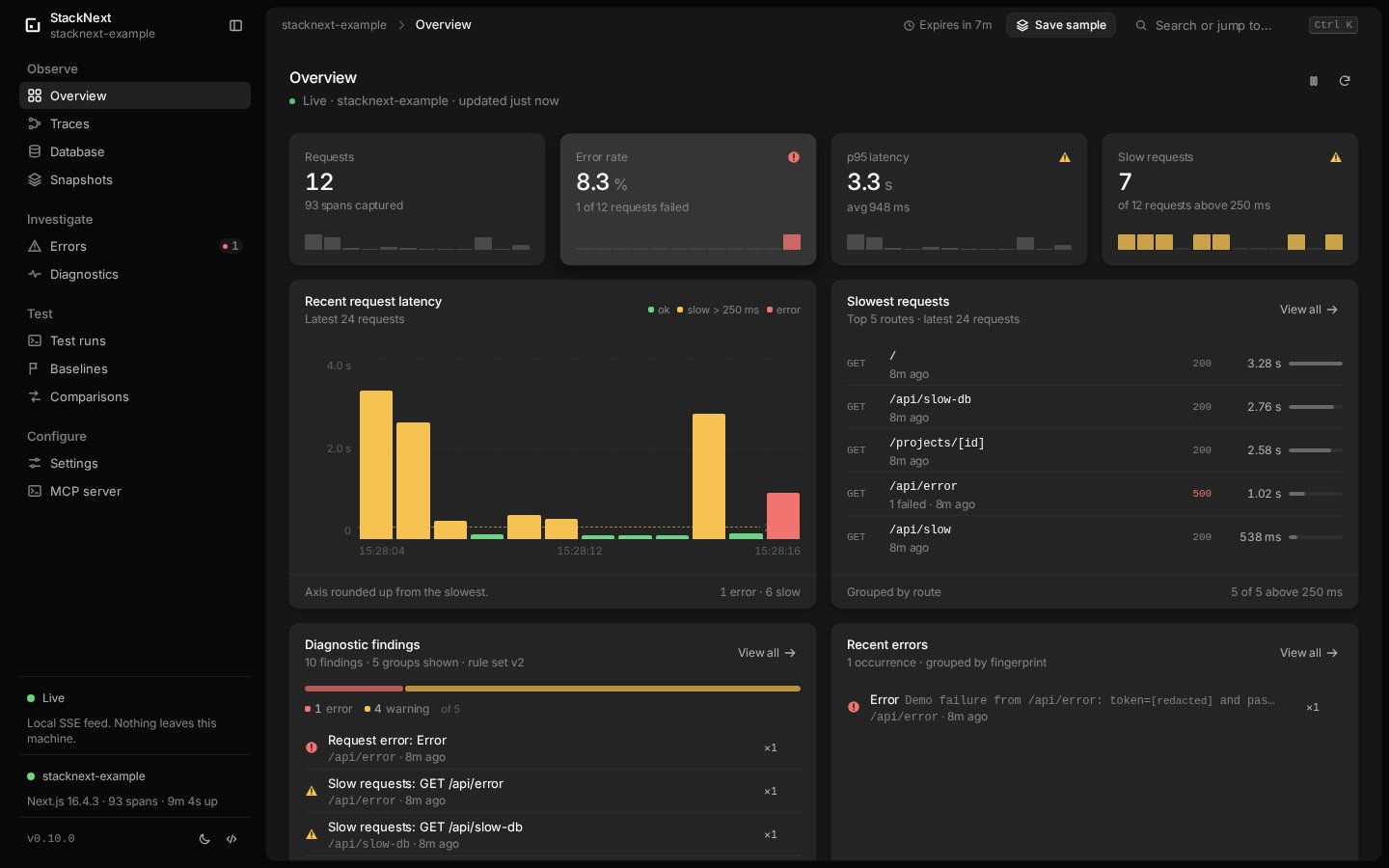
StackNext shows you what your Next.js app actually did at runtime. It collects OpenTelemetry spans, Drizzle and Prisma query events and request errors from your development server, keeps them in a bounded local sample, and exposes that evidence in a dashboard, a CLI and a read-only MCP server. It also derives deterministic diagnostic findings from the same sample, freezes redacted snapshots, and compares Playwright-linked captures against saved baselines. Everything runs on your machine: there is no account, hosted backend, AI API client or outbound telemetry.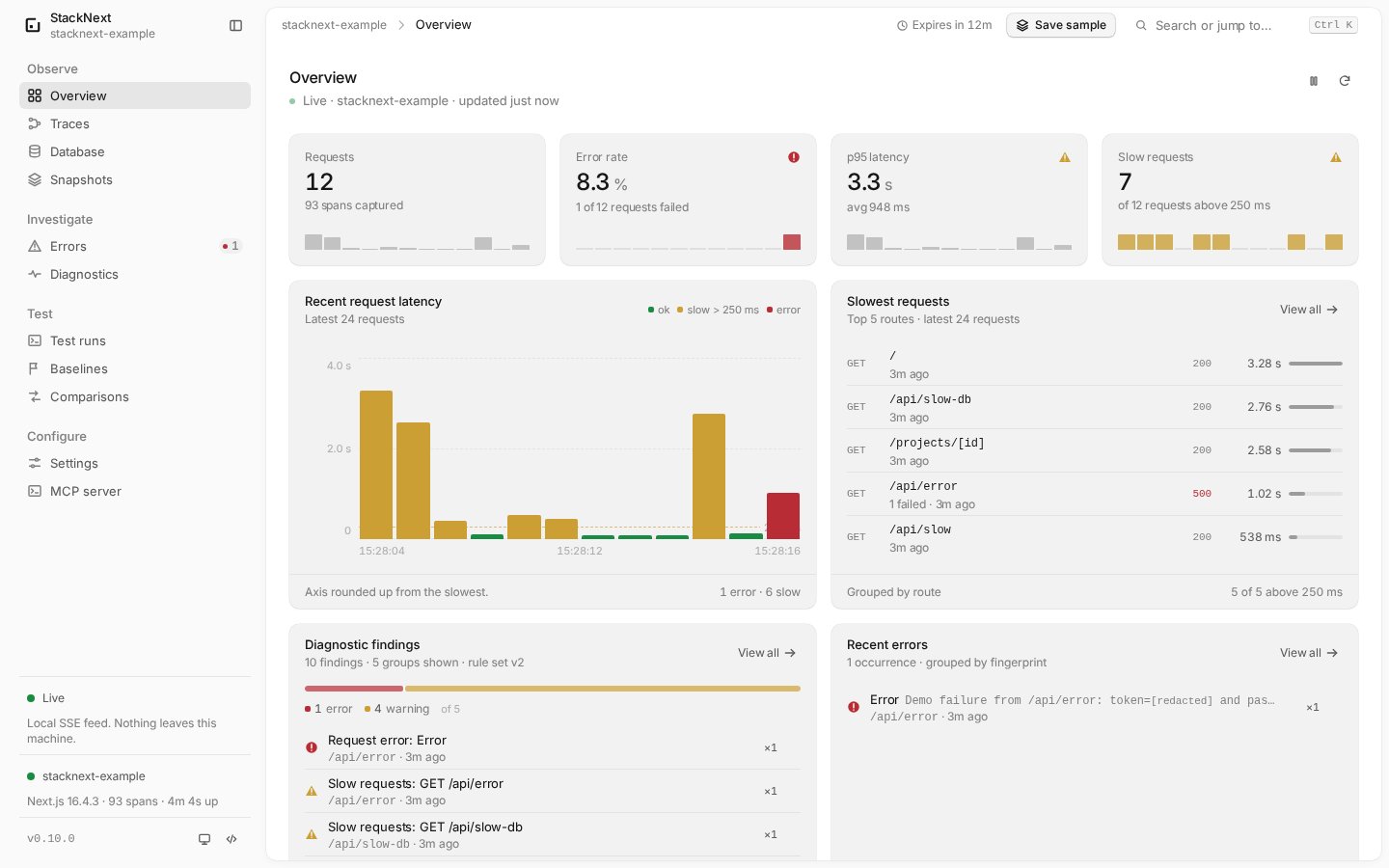
Start here
Install
http://127.0.0.1:4400, and make a request to your app. init never overwrites
an existing instrumentation file; it prints the hook to add instead.
What StackNext is not
StackNext is a development tool, not production APM. It supports Next.js 15 and 16 with the App Router on the Node.js runtime only. It never captures request or response bodies, headers, cookies, URL query values or SQL bind parameters, and it does not run SQL, edit source code or call an AI provider. See limitations and privacy for the full boundary. The npm packages also ship their own version-matched documentation. When you are writing code against an installed API, readnode_modules/@stacknext/<package>/docs/ first. See
local documentation.