

stacknext diagnose, JSON
export, the read-only MCP tools and the Agent Skill.
Diagnostics never call a model, run SQL, read source files or change your code.
The six rules
These are conservative heuristics. They do not prove an ORM bug, a causal
bottleneck, a retry policy problem or a shared error cause. Read the evidence,
verification steps and limitations on each finding.
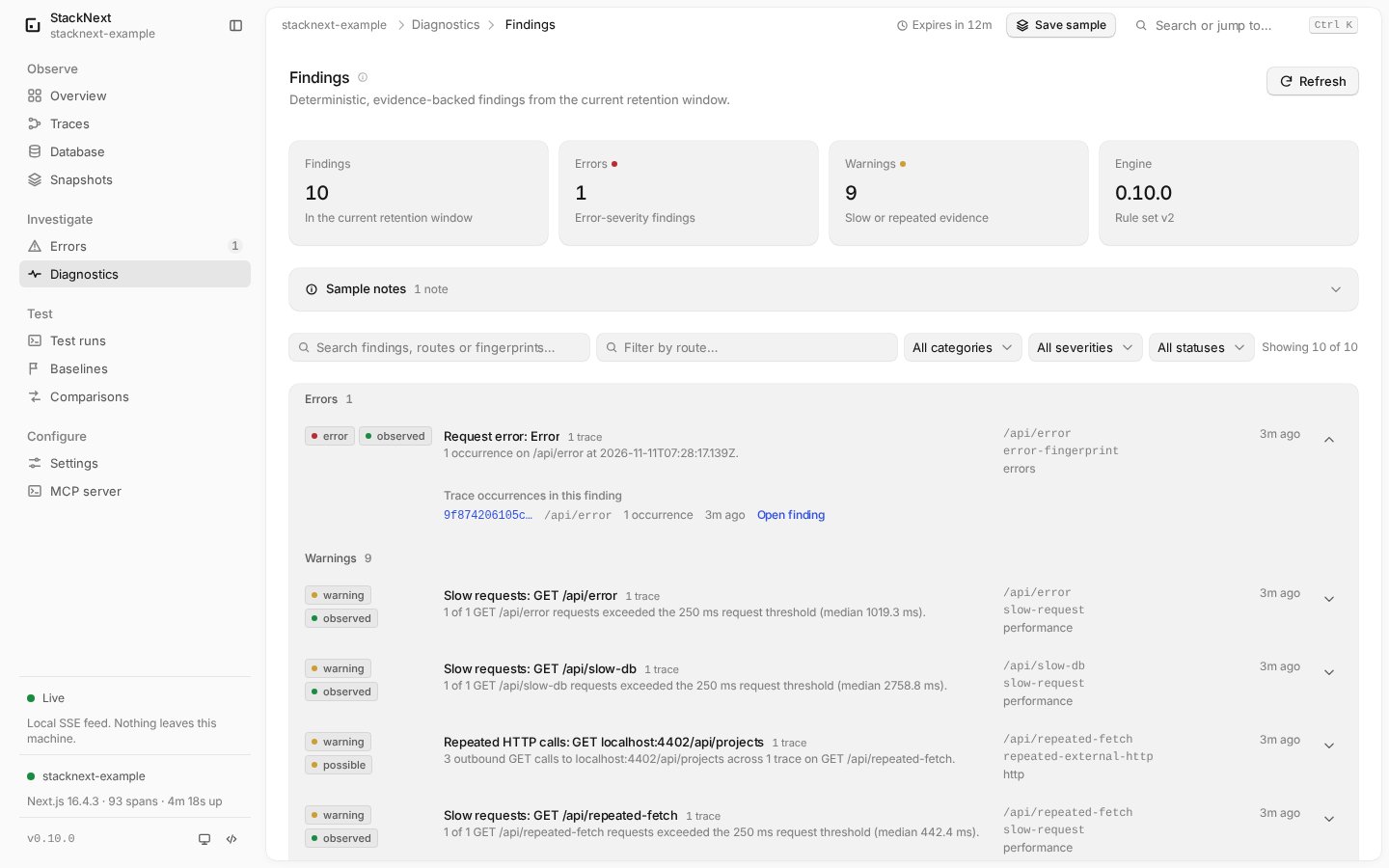
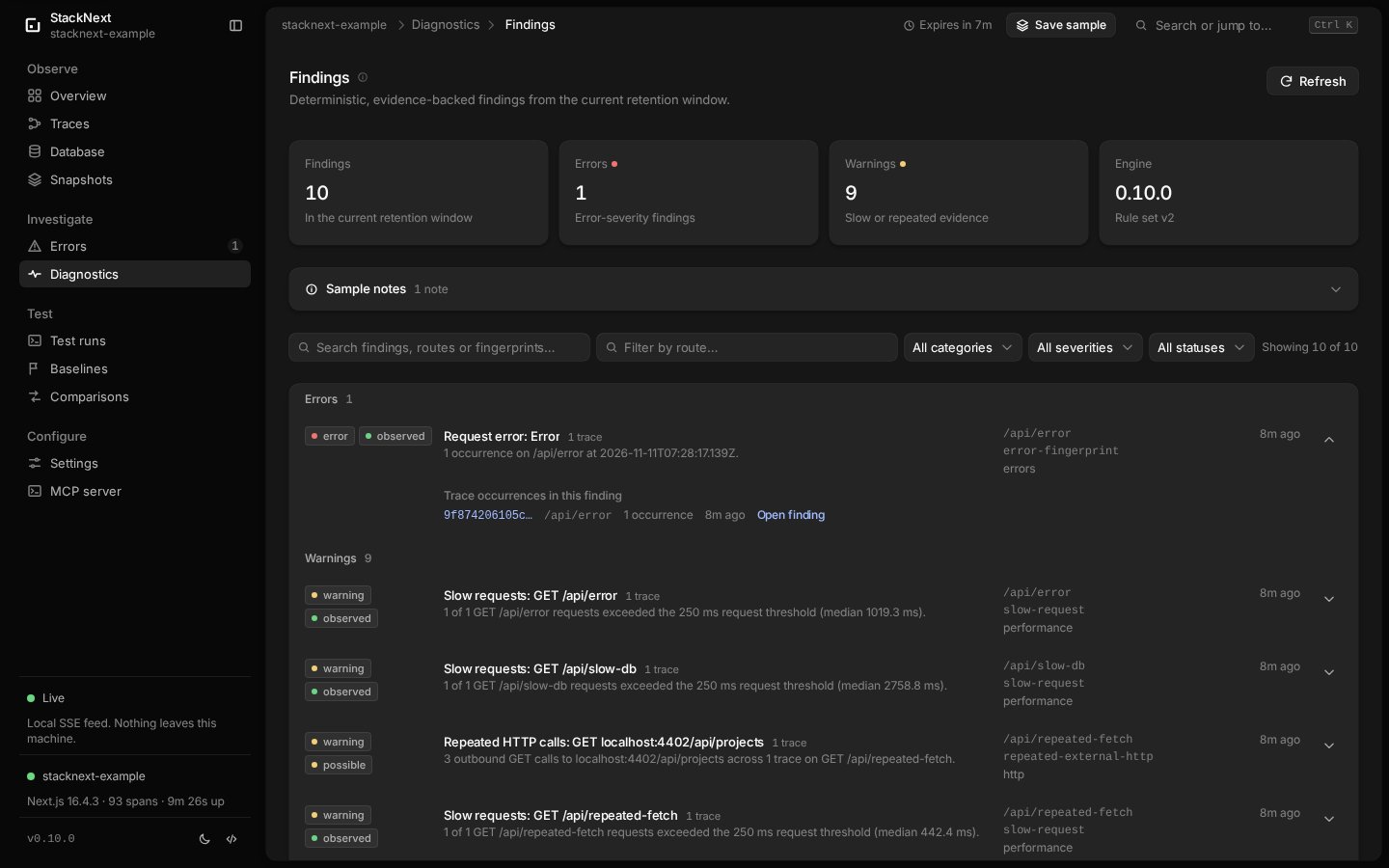
Read a finding
A finding contains:- a deterministic
diag-id for the current sample; - the rule, category, severity and status;
- the affected route, time window and trace count;
- a fingerprint of the normalized evidence;
- bounded evidence such as slow-span contributors, trace occurrences, error occurrences, query shapes or Next.js phases;
- verification steps and limitations;
- a reference to a related trace when one is available.
possible— the pattern is consistent with a problem.observed— the evidence was measured directly.insufficient-evidence— the sample cannot support a conclusion.
Severity is separate from status. A high-severity finding still needs
verification, and a capped report (
maxFindings) is not a complete inventory.CLI
Dashboard and MCP
The dashboard/diagnostics page lists findings and /diagnostics/:id shows
one finding with its evidence and related trace.
In MCP clients:
stacknext_list_diagnosticsfilters by category, severity, status, rule, route, trace id, time, query and pagination.stacknext_get_diagnosticreturns one finding plus bounded evidence and a related trace reference.
get_trace also returns diagnostic references, but they are pointers. Call
stacknext_get_diagnostic for the evidence. The MCP server is read-only and
cannot create, acknowledge or delete findings.
What diagnostics cannot do
- Execute SQL or
EXPLAIN, inspect source code or recommend indexes. - Detect long-term anomalies or alert.
- Call an LLM or external service.
- Turn
not-observedcoverage into proof that a feature is broken. - Establish causality or statistical significance.